Description
September 25, 2026
33rd World Championships – Road Race 2026 🇨🇦 (WC) MU23 – Montreal – Montreal : 174,2 km
World Championships – Road Race is a UCI World Championship one-day road race,
Show more...
September 25, 2026
33rd World Championships – Road Race 2026 🇨🇦 (WC) MU23 – Montreal – Montreal : 174,2 km
World Championships – Road Race is a UCI World Championship one-day road race, bringing together national teams on a course designed to test endurance, climbing ability and tactical positioning. The route typically combines long paved sections with rolling terrain, short to medium climbs, technical descents and urban finishing roads. Climbs can range from gentle 4–6% rises to steeper ramps above 10%, creating repeated changes of pace rather than relying solely on one major ascent. Narrow roads, sharp corners and exposed sections can make positioning important, while wind and changing weather may influence how the peloton moves. Racing usually begins with controlled breakaway attempts before the pace increases on the more selective terrain. National teams must balance chasing escapes with conserving riders for the later stages, while repeated climbs gradually reduce the field. As the finale approaches, attacks and counterattacks become more frequent, often leading to a reduced group. The finish can develop into a late solo move, small-group sprint or uphill acceleration depending on the course profile.
Ashlin Barry (USA) claimed the country’s first ever under-23 road race title in the UCI Road World Championships, pulling off an audacious 30-kilometre solo attack from a five-rider breakaway that had already been off the front for more than 100 kilometres.
Barry said he only went on the attack to get ahead and save some energy on the climbs for when the attacks came from the strongest riders.
“I didn’t really think I would be strong enough to follow the the best guys on the climbs. Once I was away, I just committed. Honestly, I didn’t think I could do it until until the last lap when I reached the top of the last climb.
“Just complete disbelief, honestly.”
It was a massive birthday present for the dual Canadian-American citizen – the son of former pros Michael Barry and Dede Demet-Barry – who turned 19 today and was the eighth-youngest rider in the field.
He gave North America something to celebrate after the region had been shut out of the under-23 men’s medals since Taylor Phinney (USA) tied Canadian Guillaume Boivin for the bronze in 2010.
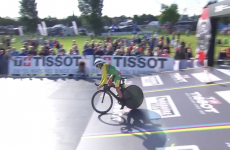
Smiling for the cameras and waving to the crowds as he climbed to the finish, Barry crossed the line with his chasers well out of sight.
It was 53 seconds before Hector Alvarez (Spain) out-sprinted the remnants of the breakaway for the silver, banging his bars in frustration, while Jesper Stiansen (Norway) took home the bronze.
Barry lives in Toronto, and had ample support around the course as both the host country and the US fans who travelled to Montreal were cheering him on as he worked to hold off his chasers.
“It was just unreal being out there, seeing so many so many friends, seeing my family. I could hear my dog barking on the side of the course,” Barry said.
“It really felt like a home race out there. I just have to say I’m like so so grateful for for the support I had, and yeah, there’s just so many people I have to have to thank.”
The result exceeded his expectations for his home Worlds, especially after he finished off the podium in the time trial.
“Honestly, I didn’t didn’t think it was possible,” Barry said. “I thought maybe at best I could get get a medal or something or a nice result. I thought maybe in the TT – I could have a chance, but to to win on this course is just unbelievable.”
For Álvarez, third in the time trial, it was a difficult pill to swallow missing out on another world title.
“Ashlin was just stronger,” the Spaniard said. “It was only me and the group against him, he was super strong and I need to congratulate him.
“I wanted to arrive at the front, but I have two [medals] – not the one I was coming for… but I am happy, in any event.”
Stiansen, however, was happy to reach his goal of landing on the podium.
“It was a crazy hard sprint and also a hard race – to come with third place is amazing. It was our goal today, but to do it, it’s never easy,” he said.
“It was full guys all day and crazy chaotic. Luckily, I found my legs during the last lap, so I could attack up to the front group, and I’m super happy to end it off with the third place.”
How it unfolded
The under-23 men lined up under sunny skies ready to take on 13 laps of a 13.4km circuit for a total of 174.2km and 3,497m of elevation. The circuit started on the Avenue du Parc and include two main climbs: Camillien-Houde to the top of Mount Royal, Côte de la Polytechnique, and then tackle the uphill drag to the finish back on Avenue du Parc.
Frank Ragilo (Estonia) made the first move early in the opening lap as the sun was just peaking above the skyscrapers of downtown Montreal. He was joined by Mads Landbo (Denmark), Filip Durdyk (Poland) and a rider each from Spain and the USA but the breakaway only gained ten seconds and was brought back before the end of the lap. There was plenty of action at the back, with riders getting tailed off, touching wheels and falling, or suffering mechanicals. Ben Wiggins (Great Britain) was forced to chase back on, too.
Before the end of the first lap, Kristian Egholm (Denmark) followed his teammate’s lead and attacked, pulling away with Viktor Soenens (Belgium) and William Heffernan (Australia), with Romet Pajur (Estonia) trying to bridge.
Before the end of the lap, the breakaway had swelled to 13 riders with Enea Sambinello (Italy), Pierre Basset (France), Timothee Coudiere Cantin (France), Landbo, William Holmes (Australia), Halvor Dolven (Norway), Jaider Muñoz (Colombia), Dawid Lewandowski (Poland), Mil Morang (Luxembourg) and Alejandro Granados (Costa Rica). They were chased by Enaut Urcaregui (Spain) and Jaka Marolt (Slovenia) at 13 seconds, and the majority of the peloton at 50 seconds at the end of lap 2.
When a powerful chasing group set off in pursuit, with Cameron Rogers (Australia), Noah Andersen (Denmark), Victor Loulergue and Ugo Fabries (France), Jasper Schoofs (Belgium), David Haverdings and Guus van den Eijnden (Netherlands), Samuel Novak (Slovakia), Ashlin Barry (USA), Ben Wiggins (Great Britain) and Patryk Goszczurny (Poland), the peloton quickly shut it down, and the race was all back together on the fourth lap.
An attack then came from Samuel Novak (Slovakia), with William Heffernan (Australia) bridging across along with Mattie Dodd (Great Britain), Kristian Egholm (Denmark) and Ashlin Barry (USA).
By the end of the sixth lap, the five riders had pushed their lead out to just over two minutes, but an attack from Dodd at the start of the seventh lap with 75km remaining, saw him go clear of the group and force a chase from Heffernan, Novák and Barry, completely distancing Egholm from the breakaway.
The efforts were short lived and the quintet reconnected before the start of the eighth lap but their lack of cooperation had reduced the gap to 1:45.
By the time they reached the ninth lap, a six rider chase group broke off the front of the field that included Matteo Scalco (Italy), Rémi Arsac (France), Matteo Van Huffel (Belgium), Max Brok (Germany), Jacob Bush (Great Britain) and Jack Ward (Australia) and were in pursuit.
Egholm found his second wind and surged on the Camillien-Houde ascent with Barry bridging the gap. The pair gained a slim seven seconds on Dodd, Heffernan and Novák. However the remnants of that original breakaway were reabsorbed into a larger selection of 25 riders that formed behind, leaving Egholm and Barry out front with a 45-second advantage.
With riders from Belgium and Switzerland setting the pace, the gap to the two breakaway riders was slashed to just 30 seconds with 30km to go. Barry took his chances and surged distancing himself from Egholm.
With two laps remaining, Barry pushed on in front of a chase group of five: Matisse van Kerckhove (Belgium), Hector Alvarez (Spain) Guus van den Eijnden (Netherlands), and Cameron Rogers (Australia), with Egholm tucking in behind them. At the bell, Barry still held out hope with his gap hovering at 40 seconds over the quintet and 1:08 on the larger peloton.
As his rivals behind began to look at each other to chase, Barry just kept powering ahead and only extended his lead to win the gold medal.
Results :