Description
August 9, 2026
5th Tour de France Femmes avec Zwift 2026 🇫🇷 (2.WWT) WE – Stage 9 – Nice – Nice : 99,2 km
Tour de France Femmes avec Zwift is a UCI Women’s WorldTour classification stage race that traverses a diverse and demanding array of terrains across France,
Show more...
August 9, 2026
5th Tour de France Femmes avec Zwift 2026 🇫🇷 (2.WWT) WE – Stage 9 – Nice – Nice : 99,2 km
Tour de France Femmes avec Zwift is a UCI Women’s WorldTour classification stage race that traverses a diverse and demanding array of terrains across France, showcasing the country’s most iconic landscapes—from rolling vineyards and open plains to rugged mountain passes and technical descents. The parcours is designed to test every facet of a rider’s ability, with stages that range from flat, high-speed sprint finishes to grueling mountain ascents featuring gradients of 8–12% on narrow, winding roads. The climbs are often long and sustained, such as those in the Vosges, Alps, or Pyrenees, where the roads snake through dense forests and open pastures before culminating in punishing summit finishes. The descents are fast and technical, with sharp switchbacks and uneven surfaces that demand precision and courage. The race dynamics vary dramatically depending on the stage profile. The flatter stages are typically contested in high-speed bunch sprints, though crosswinds on exposed roads can split the peloton and create opportunities for late breaks. The hilly and mountainous stages, however, are where the race truly unfolds, with attacks launching on the steepest sections or during the technical descents, where gaps can open quickly. The peloton often fractures into smaller groups on the most demanding climbs, while the flatter stages allow for more controlled racing and tactical maneuvering. The finish styles range from uphill sprints on steep, short climbs to reduced-group finishes after long descents or solo moves on the most challenging stages. The Tour de France Femmes is a race of endurance, strategy, and versatility, where the interplay of terrain, weather, and tactics creates a dynamic and unpredictable test for the world’s best riders.
Demi Vollering (FDJ United-SUEZ) used the final gradients of the Col d’Èze to get rid of her rival Kasia Niewiadoma-Phinney (Canyon-SRAM) and solo to the stage win and overall Tour de France Femmes victory in Nice.
Vollering nullified all of the Polish rider’s attacks before putting in the winning blow and opening up more than a minute on the 15-kilometre run-in to the finish.
On the plateau and the descent to the finish line, Vollering extended her lead further while Niewiadoma-Phinney was caught by a chasing group of five, from which Paula Blasi (UAE Team L’IMAD) sprinted to second place on the stage ahead of Niewiadoma-Phinney.
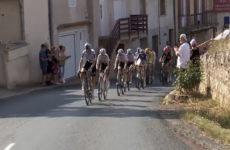
On a circuit stage around Nice consisting of four laps of the Col d’Èze, Canyon-SRAM had blown the race apart on the second lap with Zoe Backstedt pulling from the bottom to the top of the climb and over the plateau, reducing the ‘peloton’ to only 11 riders and dropping Marlen Reusser (Movistar), third overall going into the stage, who then crashed on the descent.
Juliette Berthet (FDJ United-Suez) controlled the descent and the third climb of the Col d’Èze, where Isabella Holmgren (Lidl-Trek) attacked. The Canadian gained over a minute on the climb but lost ground on the descent and the flat, and when Antonia Niedermaier (Canyon-SRAM) started to pace on the final climb via the steep Chemin du Vinaigrier, Holmgren was caught with 19.2km to go, just at the start of the steepest kilometre of the climb.
Niewiadoma-Phinney launched her attack right away, but Vollering could follow her, and the two riders traded attacks, with neither able to drop the other before the road briefly flattened out. Vollering then waited until the last kilometre of the climb, and her acceleration 800m from the top finally cracked Niewiadoma-Phinney, who had to let a gap open up.
Vollering stormed up the last bit of the climb to increase her lead, then flew down the descent to win with a gap of 1:14 minutes. Niewiadoma-Phinney finished as overall runner-up while Elisa Longo Borghini (UAE Team L’IMAD) moved into the last GC podium spot.
“I never won in the yellow jersey before. I thought about my team; I thought about Célia [Gery] who had a really, really rough night. I thought about all the work I did before this. I thought about the people behind me, working together with Specialized on the new bike, they made this bike to be the fastest downhill, to be the fastest uphill. It’s incredible the people I have around me. It’s not only the dream to win in yellow here, to win a second Tour de France, but it’s the dream to live this life, to work hard together with people with a lot of passion,”
“I had to try to attack. To go alone because I wanted to make it clear that we didn’t win because of an incident yesterday. I wanted to make it clear that we as a team deserve to win a beautiful Tour de France Femmes, with humility and with pride,” Vollering continued.
Vollering had moved into second place overall after the stage 4 ITT but was then leapfrogged by Niewiadoma-Phinney who took yellow on the Mont Ventoux.
“I didn’t have doubts on my own level. I just gambled a bit too much, and that’s sport, sometimes you win, sometimes you lose, sometimes you make the right decisions, sometimes you make mistakes. It’s just the easiest when you attack, and that’s what Kasia did on the Mont Ventoux. She won a beautiful stage there, and that’s what I did today,” she finished.
How it unfolded
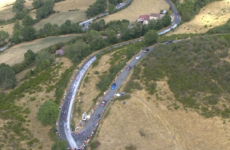
The final stage was 99.2km long, starting and finishing on the Promenade des Anglais in Nice. It consisted of four laps of the Col d’Èze, the first three laps taking the well-known route on the Grande Corniche for a second-category climb and the final lap using the Chemin du Vinaigrier for a shorter but much steeper climb classified as a category 1.
The first lap was neutralised to the bottom of the climb where the attacks started right away. Loes Adegeest, Riejanne Markus (both Lidl-Trek), Mavi García, Dominika Włodarczyk (both UAE Team L’IMAD), Émilie Morier (St Michel-Preference Home-Auber93) all tried to get away, with Włodarczyk attacking three times, but none of the moves lasted long.
Finally, Maëva Squiban (UAE Team L’IMAD) got a small gap on the last 500m of the climb, and Morier attacked again on the plateau after the QOM sprint, bridging to Squiban at the start of the descent where they were both caught again.
Malwina Mul (Cofidis) attacked in the downhill, and Paula Ostiz (Movistar) came across to make it a front duo. At the intermediate sprint after the first lap, they were 16 seconds ahead of the peloton, where Lorena Wiebes (SD Worx-Protime) had sprinted away to take the remaining points and secure her green jersey.
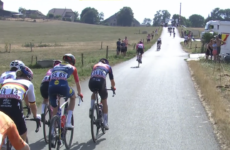
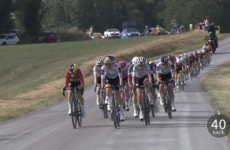
Canyon-SRAM then came to the fore, catching the breakaway duo at the start of the second climb up the Col d’Èze, where Backstedt effectively did a climbing time trial, riding all but 11 riders off her wheel.
50 seconds behind the front at the QOM and with her GC podium spot in danger, Reusser crashed on the following descent and stayed on the ground for several minutes. She could eventually continue the race but finished in the gruppetto and dropped out of the top-ten of the GC.
On the third time up the Col d’Èze, Juliette Berthet (FDJ United-Suez) set the pace at first. After a brief turn by Holmgren, Cédrine Kerbaol (EF Education-Oatly) attacked but was quickly neutralised by Berthet, who continued to ride tempo at the front.
Holmgren dropped back a few positions and then attacked from behind with 46km to go, 1.3km into the 7.7km climb, and quickly got a gap. She extended her advantage to 1:08 minutes at the top of the climb, 39.6km from the finish, but lost time again in the descent and started the final lap 45 seconds ahead of the group of favourites, still led by Berthet.
The 21-year-old Canadian started the final climb with 32 seconds in hand, but white jersey Antonia Niedermaier (Canyon-SRAM) took over from Berthet and closed the gap to Holmgren over the first 2km of the climb, making the catch just before the steepest part, over a kilometre at an average 12%, began. Holmgren was awarded the stage combativity prize for her breakaway.
Niewiadoma-Phinney attacked just as Holmgren was caught, but Vollering had no trouble following the move. The two riders traded blows, each attacking the other several times, but they were evenly matched. At the Col de Quatre Chemins, where the route returned to the main road up the Col d’Èze for the already-familiar last 2.3km of climbing, they were 19 seconds ahead of a chase group including Longo Borghini, Niamh Fisher-Black (Lidl-Trek), Holmgren, Blasi, and Niedermaier.
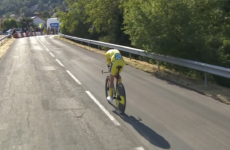
Vollering and Niewiadoma-Phinney briefly worked together to keep the chasers behind until the yellow jersey attacked from behind 800m before the top. Niewiadoma-Phinney jumped on the wheel, but Vollering kept going and quickly opened a gap.
From there on, she only extended her advantage and could celebrate her second stage win of the 2026 edition as well as her second overall victory of the Tour de France Femmes on the Promenade des Anglais.
Puck Pieterse (Fenix-Premier Tech) had already started the stage with an insurmountable lead in the mountain classification and safely finished the stage to win the polka-dot mountain jersey. Niedermaier finished fourth overall and won the white U24 jersey, while Niewiadoma-Phinney won the overall combativity prize and UAE Team L’IMAD won the team classification.
Results :
Final General Classification :