Description
July 15, 2026
113th Tour de France 2026 🇫🇷 (2.UWT) ME – Stage 11 – Vichy – Nevers : 161,3 km
The 113th edition of the Tour de France starts in Barcelona on July 4 and ends three weeks later.
Show more...
July 15, 2026
113th Tour de France 2026 🇫🇷 (2.UWT) ME – Stage 11 – Vichy – Nevers : 161,3 km
The 113th edition of the Tour de France starts in Barcelona on July 4 and ends three weeks later. Riders have to cover all 21 stages of the 2026 Tour de France route. The rider who completes the distance in the fastest time wins the race, also known as the ‘overall classification’. Each day, the rider who has completed the entire distance raced the quickest is the leader of the Tour de France, and wears a yellow jersey to signify him as such. There is a secondary time classification for the best rider under the age of 26, the best young riders’ classification, and he wears a white jersey if leading. Riders also gain points for their position at the end of each day of racing, known as “stages”. There is a secondary prize for the rider who gains the most points – the points classification, and the leader each day wears a green jersey. There are also points atop a select number of mountain passes for the first riders to cross the top, with more points available the harder the mountain is to climb. The leader of the mountains classification wears a white jersey with red polka dots.
Søren Wærenskjold (Uno-X Mobility) held off all the big-name sprinters with a long-range sprint to win stage 11 of the Tour de France and deliver a second-ever stage win for his Scandinavian team.
After a bit of a sprint team stand-off in the final 5km, the sprint kicked off properly with 2km to go, and it was Decathlon CMA CGM’s whose lead-out efforts almost turned into a late flyer for Cees Bol in the final few hundred metres, which Wærenskjold followed and came past and amazingly held off the charging sprint field.
It was very tight on the line, with Olav Kooij (Decathlon CMA CGM) second and Jasper Philipsen (Alpecin-Premier Tech) crossing the line in third after a late wobble in the frenetic sprint. Philipsen was relegated after the finish, with Milan Fretin (Cofidis) moving onto the podium, but then officials reversed the penalty and reinstated the Alpecin rider to his original placing.
There was to be no hat trick for Tim Merlier (Soudal-QuickStep), who finished outside the top 10 in Nevers.
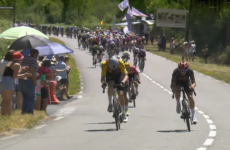
A breakaway of four riders had been away for almost all of the day, but the three survivors were caught with 6km to go as things came back together for the expected sprint.
With all the GC riders finished safely in the bunch, there were no major changes to the overall, with Tadej Pogačar (UAE Team Emirates-XRG) continuing in the yellow jersey for another day.
Having Anthon Charmig in the day’s breakaway was surely a big benefit for Uno-X, as they did not have to do the work all day that teams like Soudal-QuickStep and Alpecin did, which left him with a stronger lead-out for the finale, to go along with his opportunistic move and clear strength.
“I thought I was too far back, and then it opened up on the right hand side, which it usually doesn’t do,” Wærenskjold explained. “It was a bit the same feeling as my first big win in Omloop Het Nieuwsblad, also then I was too far back and then suddenly at the front. It’s unbelievable.
“It means everything. It’s my biggest win so far. Like I said when I came here, I knew that there are two or three guys who are faster than me but if I’m lucky and I have a good sprint, like today, then it’s possible,” he continued.
“Sometimes I have really good confidence and I believe in myself, but there’s many times where I feel super tired and like it’s impossible to win here, so it’s crazy that it happened today. Also after the crash I felt really shit in the start but my body got hoing and I felt better in the final with adrenaline and everything.”
Uno-X have had a whirlwind race so far, taking the yellow jersey with Torstein Træen but then losing him to a crash just two days later, but they have now added a win in 2026 to Jonas Abrahamsen’s breakaway triumph in 2025.
“To finish it off for the team – we’ve had some quite highs and lows in this race – it’s incredible to take this win,” Wærenskjold said. “I just have to let it sink in, and then I will probably be more happy than I look now, but it’s a big surprise for myself.”
A lightning fast day in central France
Stage 11 from Vichy to Nevers was almost entirely pan-flat with less than 2.5km of climbing, so it was a nailed-on sprint day, but that didn’t stop riders from wanting to go in the break. And in fact, in contrast to the very easy break formations we’ve seen in other flat stages, there was a fairly active battle to get away as big teams tried to police who was allowed in the day’s escape.
Thankfully it didn’t take too long, though, and the ‘right’ move managed to get away after around 11km, formed of local man Julian Alaphilippe (Tudor), Anthon Charmig (Uno-X Mobility), Nelson Oliveira (Movistar) and Mathis Le Berre (TotalEnergies). Former breakaway hero Liam Slock (Lotto Intermarché) chased for a while but gave up when it was clear he was not going to make the junction.
Le Berre won the intermediate sprint after 28km, with Jasper Philipsen (Alpecin-Premier Tech) best of the bunch to secure the maximum remaining points behind. Charmig won the singular KoM point available atop the Côte de Billonnière, with the break holding a fairly tight lead of only 1:30.
After the first climb, it was status quo for much of the middle part of the day, with nothing of particular note happening for most of the next 60km. Heading towards the final 50km, the pace in the peloton started to increase with Soudal-QuickStep, Decathlon CMA CGM and XDS Astana sharing the duties to bring the gap down to a minute with 45km to go.
Hitting the second and final categorised climb, which was only 1.4km long, Alaphilippe began to struggle quickly and was dropped from the break with 38km to go as Charmig won the point again. Losing Alaphilippe, who was probably not contributing much strength to the break, was possibly actually a help for the break, who managed to grow their gap back out to 1:10, whilst NSN had to join the chase behind.
With 32km to go, a crash in the back of the bunch in a bottle hand-up zone saw Georg Zimmermann (Lotto Intermarche), Abel Balderstone (Caja Rural-Seguros RGA) and Ben O’Connor (Jayco AlUla) crash, with Zimmermann worst off but he got back riding eventually.
Despite the peloton holding the break close all day, it did not prove easy to reel the three leaders back in, and their lead was still 50 seconds with 25km to go, but finally falling more consistently at this point, so there wasn’t much reason to hold out hope of a surprise.
A chaotic sprint
The slightly tricky run-in towards Nevers didn’t help the break, as the constant road furniture only served to sap speed from the trio. With 10km to go, the gap was 20 seconds as the peloton had the leaders well in sight now, and despite them pushing and pushing, they were swept up with 6km to go.
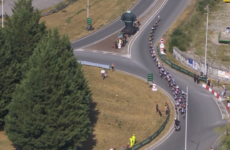
The catch ushered in a brief calming as the peloton headed onto a narrow road and the sprint teams took a moment to regroup, and this standoff lasted for a good few kilometres until the sprint kicked in properly with 2.2km to go, initiated by NSN, Uno-X and Decathlon CMA CGM.
The final kilometre of the stage was hectic with lead-outs unable to stay organised and largely all the sprinters fighting for themselves through the sweeping final turn, which resulted in Kooij’s lead-out rider Cees Bol flying off the front with a few hundred metres to go. It was a risky move to jump across to Bol, but Wærenskjold went for it, and despite it looking like there was too much road to go, the Norwegian rider impressively held off the bunch to seal his first Tour stage victory.
With the other sprinters coming up super fast behind him, Kooij, Philipsen and Fretin just ran out of road before the line and had to settle the final podium, whilst Merlier struggled in the messy sprint and finished way down in 16th.
Results :